



Our 2025 Digital Future of Work Report found forward-thinking Queensland business owners and leaders are starting to use artificial intelligence (AI) to streamline operations, improve customer engagement, and boost productivity. However, while the fog of uncertainty around AI is lifting for some, the report also revealed many businesses are still only scratching the surface of what’s possible.
With the Federal Government recently launching its National AI plan, understanding the opportunities and challenges posed by this technology is fast becoming business critical.
AI adoption is growing, but we risk being left behind
In 12 months, the number of Queensland businesses using AI ‘extensively’ has doubled – from 5% in 2024 to 10% in 2025. That’s a promising sign of momentum, however, the report also shows 8 in 10 businesses are only using AI for simple tasks such as searching and drafting emails or are not using it at all. That means the vast majority are still navigating the early stages of AI adoption.
The untapped potential of AI
AI has the power to transform how businesses operate, from automating repetitive tasks and enhancing customer service to unlocking new revenue models and improving decision-making. And Queensland businesses are not yet realising the full potential of this technology.
Many are eager to explore AI but lack the internal capability, strategic guidance, or confidence to move beyond experimentation. This is especially true for small and medium enterprises (SMEs), which face resource constraints and competing priorities, making it difficult to dedicate time to AI training.
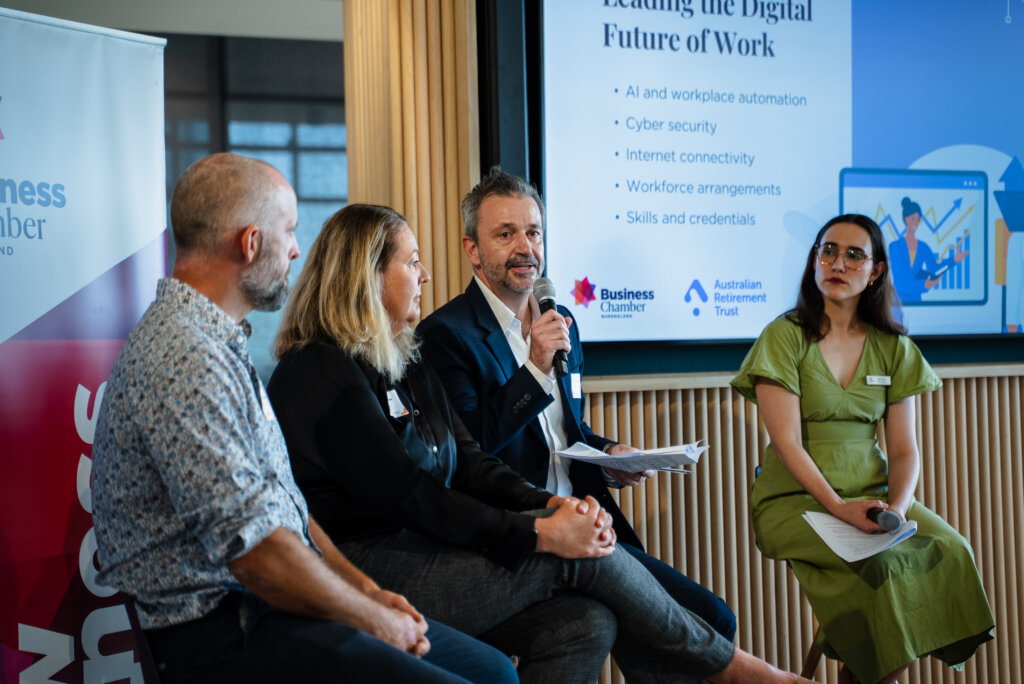
Following the release of the Digital Future of Work Report in Brisbane earlier in the year, alongside Australian Retirement Trust, we took it on a tour of the state, visiting Cairns, Townsville, Mackay, the Gold Coast, and the Sunshine Coast. While the report explores the broader opportunities and challenges associated with digital transformation, including cyber security, internet connectivity, workplace arrangements, and workforce skills, the discussion at these events inevitably focused on AI and automation.
Businesses on the ground are excited by the opportunities it presents, but they’re unsure how to apply it.

Cyber security: A growing threat
While AI and automation dominated the conversation, the report also made clear that cyber security remains a critical concern for Queensland businesses – and as AI adoption accelerates, so too does the threat of sophisticated cyber attacks.
In the past 12 months, 11.6% of businesses experienced a cyber attack, a slight improvement from 2024. Encouragingly, preparedness levels are rising: the average readiness score for a potential attack or data breach increased from 5.8 in 2024 to 6.2 in 2025. 10% of businesses now consider themselves highly prepared, and more than half largely prepared.
However, nearly one third (29%) of businesses remain unprepared, and 84.5% identified a need to train staff in cyber security. This highlights a pressing gap: when Queensland businesses are investing in AI and digital tools, many will lack the foundational security measures to protect these investments.
Cyber security is more than an IT issue, with attacks impacting business continuity, customer confidence, and insurance costs, as well as causing direct financial losses. As Queensland businesses embrace digital transformation, robust security practices must be embedded into strategy, governance, and workforce training. Without this, the benefits of AI and automation could be overshadowed by costly breaches and reputational damage.
Support is critical for capability building
More than half of Queensland businesses identified a strong or critical need for new skills and retraining to adapt to the future of work, and 82% believe leadership skills are essential to drive effective use of AI and digital technologies.
These findings and the ongoing discussion at events highlight a strong need for support to help businesses understand where the opportunities and risks lie in implementing AI and to build the baseline skills needed for secure experimentation and adoption.
Without targeted investment in digital capability building – for example, through training, government and industry partnerships, and accessible business tools and resources – there’s a real risk that Queensland will fall behind.
What’s next?
To truly capitalise on AI, Queensland businesses need:
- Tailored training programs that build digital literacy and leadership capability.
- Access to practical tools and case studies that show how AI can be applied in real-world business contexts.
- Collaboration between government, industry, and education providers to co-create solutions that meet business needs.
- Support to ensure new systems and processes are safeguarded against increasingly complex cyber attacks.
The 2025 Digital Future of Work Report is a call to action. It’s time to move from cautious curiosity to confidence – and to encourage Queensland businesses to not just keep up with technological change but lead it.